New Curriculum, Same Teacher: Making Room for What Works
When your district adopts a new curriculum, it’s easy to wonder what you’ll have to leave behind, but Project Read Fellow Christina Borger is keeping what works and building on it.
 Christina BorgerKindergarten Teacher
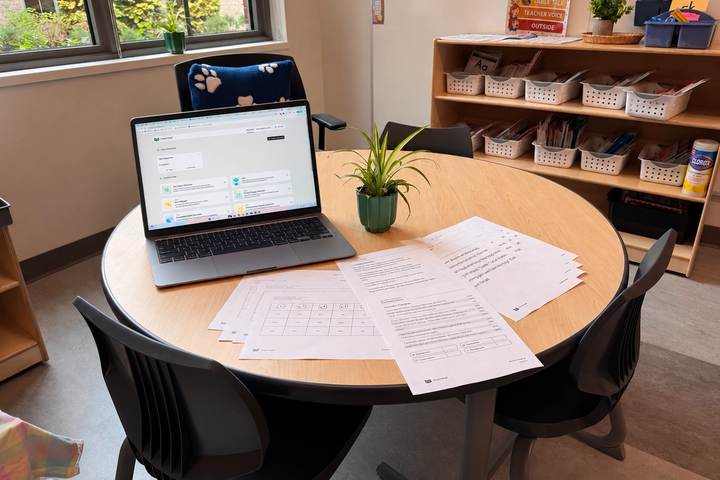
There are few phrases that can make a teacher's mind start spinning quite like “We’re adopting a new curriculum.”
Suddenly, the routines you have refined, the resources you have created, and the instructional practices you have come to rely on can feel as though they have been swept off the table to make room for something new. This year, I found myself in exactly that position. As I prepared to welcome a new class of kindergarteners, my district pivoted to a new foundational literacy curriculum, and I had to rethink what literacy instruction would look like in my classroom.
But adopting something new doesn’t mean we have to throw the baby out with the bathwater - as the saying goes.
A curriculum can give us a scope and sequence. It can provide lessons, materials, routines, and a common instructional language. What it cannot do is replace the knowledge a teacher brings to the classroom: knowing when students need another example, when a lesson needs to slow down, when a group is ready to move ahead, or when five-year-olds simply need learning to feel a little more joyful.
There is no single program that can replace good teaching.
So rather than asking myself, “How do I leave behind everything I was doing before?” I’ve started asking a different question:
How can I honor our new curriculum while holding onto the tried-and-true practices and tools that help me respond to the readers sitting in front of me?
That question has shaped the way I’m beginning to think about Project Read this year.
Fidelity and Finding Out What Students Actually Know
Sometimes the hardest part of implementing something new is simply figuring out how to begin. There can be a lot of hesitation around doing it “right.” Then we hear that dreaded word: fidelity.
While the phonics police may not be patrolling the kindergarten hallways, we know that ultimately, the proof will be in the data.
There is plenty of benchmark data to collect, and those assessments give us valuable information about our students. But some of the most precise information I gather comes from something much simpler: dictation.
Can students apply the skill they just learned? Can they retrieve a previously taught sound when they need it? Can they segment a word, connect those sounds to graphemes, and record what they hear? What happens when yesterday’s learning has to work alongside today’s?
Those little moments tell me a lot.
And that information becomes especially important when I begin forming small groups. A scope and sequence tells me what I am teaching. Student performance helps me determine what needs more practice, who needs more support, and who may already be ready for something more.
So, Where Does Project Read Fit?
I’ll admit: this part took some thought.
I knew I wanted to continue using Project Read, but I also knew that I needed to work within my district’s newly adopted scope and sequence. Rather than trying to make one replace the other, I started thinking about the places where Project Read could help me become more responsive within the instruction I was already providing.
As I began collecting baseline data, for example, I discovered a small handful of kindergarten students who entered school already reading. They know their consonant letters and sounds. Their handwriting could use some refining because, well, kindergarten…but their decoding needs have already moved into short-vowel work.
That immediately gives me opportunities to use Project Read.
I can create decodable passages [1] that give these students practice with the short-vowel patterns they need and even personalize those passages by putting their names into the text. I can create Roll & Reads [2] for repeated practice with targeted vowel sounds. I can also use the Tutor [3] to provide another opportunity for individualized practice.
Meanwhile, my whole-group instruction can continue following our district’s scope and sequence.
And I want to be clear: this isn’t a complaint about being bound to a sequence. A thoughtfully designed scope and sequence matters. Especially in kindergarten, my students need systematic, explicit instruction that builds the alphabetic code piece by piece.
Right now, that naturally places some boundaries around which Project Read resources make sense for my whole class. If students haven’t yet been explicitly introduced to a particular grapheme, I don’t want to hand them a passage filled with that spelling pattern simply because I have the ability to generate one.
But those boundaries are temporary.
As my students build a solid foundation with consonants and short vowels and begin blending with greater independence, the possibilities expand. Project Read can move from being a tool I use selectively for individual students and small groups to something I can integrate more broadly for targeted practice, review, differentiation, and application across the class.
And perhaps that is one of my biggest takeaways from navigating a curriculum change so far:
Integration doesn’t have to happen all at once to be meaningful.
Sometimes good implementation means knowing when to use a tool and when your students aren’t quite ready for it yet.
New Curriculum, Same Teacher
If you find yourself navigating a curriculum change this year, give yourself permission to learn the new while holding onto what you know to be effective.
Learn the new routines. Follow the scope and sequence. Dig into the research behind the program. Collect the data. See what works beautifully for your students and pay attention to the places where they need something more.
But don’t pack away everything you know about good teaching simply because a new box or a new login arrived.
Our students will never fit perfectly inside the pages of a teacher’s manual. One child may need ten more repetitions. Another may be ready to read before the curriculum says it is time. A third may understand the skill but need a different way to practice it. That is where our professional knowledge matters.
And that is also where tools like Project Read can become so valuable, not as another curriculum to squeeze into an already-full day, but as a resource we can reach for when our students show us what they need next.
I’m still at the beginning of this journey. My kindergarteners are still building their knowledge of the alphabetic code; I’m still learning who they are as readers, and I’m still discovering all the ways Project Read will fit into our literacy block this year.
And I think that’s okay.
Because thoughtful teaching has never been about using every resource, every day, simply because it is available; it is about knowing our students, knowing our craft, and choosing the right tool at the right moment.
The curriculum may be new. Good teaching isn’t.
And no program, no matter how carefully designed or how innovative, can replace the knowledgeable, responsive teacher who brings it to life.
Resources
- Decodable Generator
- Decodable Game Generator
- Tutor
- Bring Project Read to your School or District