NAEP Reading Scores Drop Again: Where Do We Go From Here?
Reading scores have declined again for fourth and eighth graders. Viv reflects on what research says works, why delivering it at scale is so hard, and why he remains optimistic about what comes next.
 Viv RamakrishnanCo-Founder/CEO, Project Read
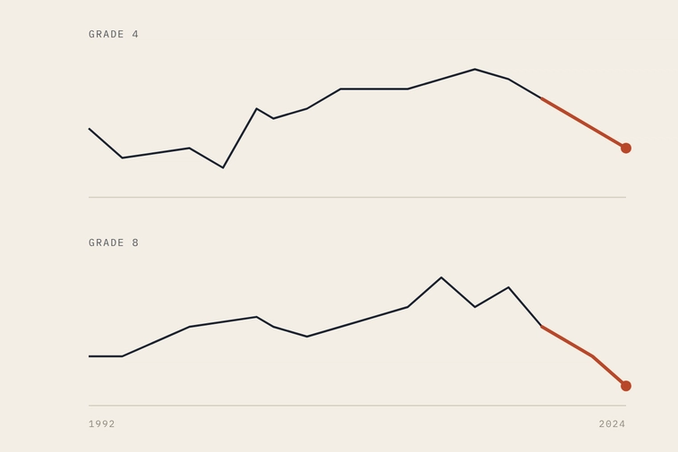
You may have seen yesterday's news about NAEP reading scores in the US. The results paint a sobering picture: reading scores have declined again for both fourth and eighth graders, with historically high percentages of students performing Below Basic level, 40% of fourth graders, and historically low levels of proficiency, 31% of all fourth graders. Behind these numbers are millions of children who are struggling.
Like many of you, my first reaction was one of sadness and discouragement. I wanted to share with you my reflections on where we go from here, and why I remain optimistic about the future.
What we know works; the challenges of doing it at scale
Two decades ago, the National Reading Panel laid out what works: systematic, explicit phonics instruction combined with high-quality instruction in the language comprehension strands of the reading rope. Yet implementing these evidence-based practices at scale has remained an enormous challenge. Teachers face an almost impossible task — providing precise, individualized support to dozens of students simultaneously, while identifying and responding to each child's ever-evolving specific skills gaps in reading. And while the efficacy of 1-1 tutoring is well documented, such support remains far outside the financial reach of most families.
I started my career in the classroom and then in school leadership, and experienced first-hand how little time I had to spend with each student individually, let alone in small groups. My own shortcomings as an educator gnawed at me, leaving me wondering how we could ensure each child cracked the code sufficiently enough to reach the escape velocity, to access the richness of the world around them and the opportunities they deserve in this life. This is why we built Project Read.
A unique moment in time: multimodal AI x structured literacy
Not long ago, we saw a unique moment of convergence: the nationwide shift toward structured literacy happening just as AI technology reached generational breakthroughs in its abilities. Not that AI is a silver bullet (it isn’t), but because when designed thoughtfully, it can serve as a force multiplier for teachers implementing evidence-based instruction and can provide the foundational skills practice with feedback that research tells us students need.
For the first time, we can create tools that aren't just point-and-click, with screens kids cannot quickly skip through. Instead, we envisioned extending what great teachers do when given fleeting 1-1 time with students learning the code: choosing developmentally appropriate decodable content, listening to the student read it out loud, and providing in-the-moment corrective phonics instruction. All while giving teachers granular phonemic data that's actually useful from their students' sessions.
So what does this mean for us at Project Read?
We have decided to extend free access to our student AI Tutor for all classrooms for the remainder of this school year. The early results we're seeing from our pilot data and from teachers using our AI Tutor consistently (10+ minutes per week) are incredibly encouraging. My ask is this: if you haven't tried it yet, I encourage you to see what's possible in your classroom. And please, send me your feedback - what's working, what isn't, what your students need. We still have a long way to go, and your voice is so important to getting it right for students.
The reading crisis reflected in today's NAEP scores is daunting. And though it may sound counterintuitive, I've never been more optimistic about our collective ability to address it — not through AI alone, but through the combination of proven instructional methods, dedicated teachers, and cutting-edge tech that can finally deliver individualized support at scale.
Thank you for being part of this journey.
With gratitude,
Viv