Introducing the UFLI Portal: developed for, by and with teachers
Dr. Holly Lane and Viv Ramakrishnan unveiled a tool that turns Friday's UFLI progress monitoring data into a ready-to-teach small group plan for the week ahead.
 Viv RamakrishnanCo-Founder/CEO, Project Read
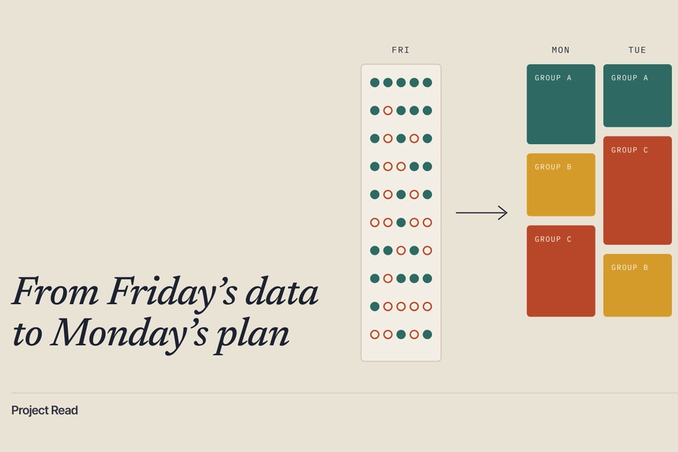
Last month, UFLI Director Dr. Holly Lane and Project Read Co-Founder & CEO Viv Ramakrishnan hosted a live webinar to unveil something teachers using UFLI Foundations have been asking for: a tool that turns Friday's progress monitoring data into a ready-to-teach small group plan for the following week.
UFLI x Project Read Overview - May 8: https://www.youtube.com/watch?v=oSbkPerFN0I
The problem: great lessons, but a data bottleneck on Fridays
Dr. Lane opened by walking through how UFLI Foundations was built starting as a pre-service teacher preparation tool, then evolving into the fully scripted lesson plans teachers use today once the team realized that expecting practicing teachers to build word chains and concept explanations from scratch on their own time simply didn't scale.
The same gap showed up again with progress monitoring. UFLI's model of mastery isn't pass/fail, it's a continuum from unfamiliar to acquainted to accurate to automatic to independent, and the weekly Friday spelling assessment is what tells a teacher where each student actually sits on that continuum for each new concept. Scoring is fast: students who nail all the new-concept points need no extra support; students who get zero or one point need intensive reteaching; everyone else falls somewhere in between and gets a shorter reteach or review.
The trouble was turning that data into action. With just 15 minutes of daily small-group time split across two concepts, teachers were expected to score every assessment, sort students into the right tiers, and match each tier to the correct manual activities for each day of the week — all in the same Friday afternoon they were also trying to leave for the weekend.
The fix: Project Read's UFLI Assessment and Planning Portal
The portal works like this: a teacher selects one or two lessons, then enters which words each student misspelled (or, in a feature debuting this fall, scans in the student's paper directly — the tool reads handwriting and pre-fills the input for the teacher to confirm before submitting). From there, it automatically:
- Sorts students into intensive reteach, reteach, review, or no-support groups for each concept
- Matches each group to specific UFLI manual activities and recommended time allocations for Monday through Friday
- Shows the underlying rationale, and why each student landed in their group
- Provides an analytics view of word accuracy, new-concept accuracy, and performance on prior GPCs
- Exports everything to a downloadable spreadsheet
The specific activity recommendations aren't AI-generated guesses, they come directly from UFLI's own team, encoded into the tool.
Pricing and what's next
The portal is $4 per student, available for individual teachers, schools, and districts. Individual teacher access is coming this fall, alongside admin-level views for schools and districts to see data across multiple classrooms. There's no cap on the number of students a teacher can enter.
Dr. Lane closed by describing the portal as a genuine game-changer for the program, not because it changes what UFLI teaches, but because it removes the heaviest lift standing between good data and good instruction.